
London Through My Lens
Updated: Feb 3
PART ONE: The Weekend Itinerary
The Art of Arriving
We landed in London on Friday, with the Design Destination market kickoff on Monday looming on our calendars, but my philosophy is that you can’t design spaces inspired by history and culture if you never stop to actually experience them.
So we started the way any reasonable design team would: staring up at Big Ben like tourists, walking the Thames as the city lights came on, and ending the night over dinner in Soho.

Augustus Pugin designed the interiors of the Houses of Parliament in the 1840s, and if you’ve ever wondered at the audacity of Victorian maximalism, look no further. The level of ornamental detail, the repetition of pointed arches, the way the whole complex sits on the Thames like it’s always been there: this is what happens when a country decides its government buildings should inspire awe. Clients often want to talk about timeless design, so it’s our job to understand and appreciate what makes something last 900 years.

We ventured out on Saturday morning to Liberty London (dangerous!), had lunch at The Ivy (necessary), and took our time at Fortnum & Mason, where I was reminded why the British are so good at making even tea shopping feel like an event.

Liberty’s Tudor Revival building from 1924 was built using timber from two old warships, and the interior feels like shopping inside a cathedral dedicated to beautiful things. But Liberty isn’t just architecturally significant; it’s the reason we have access to the textiles and patterns we take for granted today. Arthur Liberty opened the store in 1875 and became the leading importer of Japanese and Eastern textiles at a time when that was revolutionary. The Liberty prints you see everywhere now (those iconic florals and paisleys) came from the store’s textile department commissioning original designs from artists. They literally changed what was available to designers and the public. Walking through Liberty as a design professional feels like paying respects to the source.

We eventually found our way to Fortnum & Mason, which has been operating since 1707; the building itself is Georgian elegance (confession: this is my favorite architectural aesthetic), and the way they’ve maintained the heritage while modernizing the retail experience is a masterclass in respecting history without being imprisoned by it. The new double helix staircase, designed by Ben Pentreath Studio, is directly inspired by Leonardo Da Vinci’s design of a double helix staircase (talk about a timeless idea!), and it is truly beautiful.

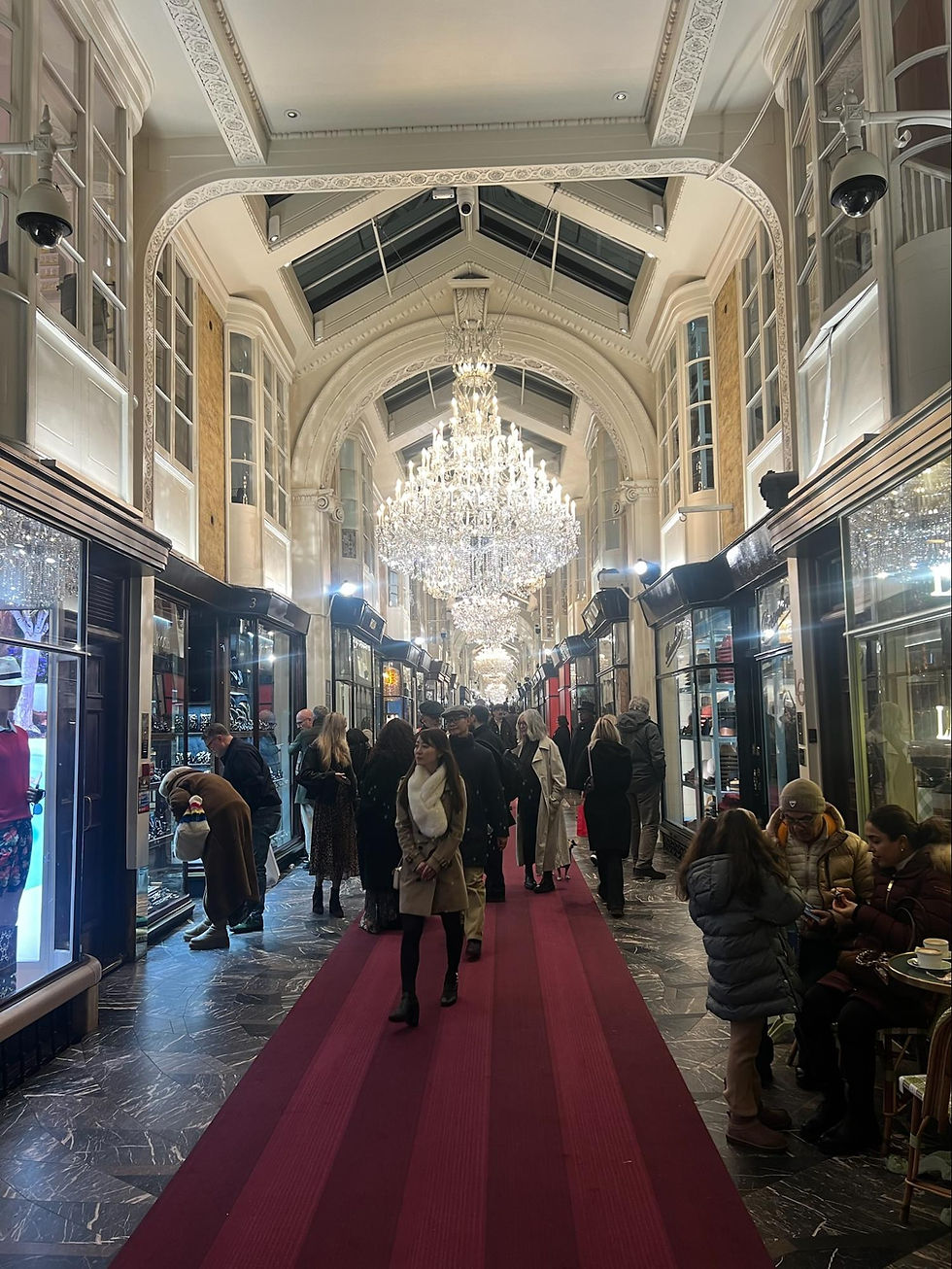
We ended up at the Burlington Arcade for macarons at L’Auderee because calories don’t count when you’re traveling. Burlington Arcade opened in 1819 as one of London’s first covered shopping streets (Regency architecture meeting early retail innovation), and walking through it still feels like stepping into a more refined era.

Sunday started at The National Gallery, where I stood in front of paintings my art history degree prepared me to appreciate and my design brain needed to see in person. The building itself is a Greek Revival masterpiece from 1838, and the way William Wilkins designed the facade to anchor Trafalgar Square shows you what happens when architecture is asked to do more than just house things. We taxied to Buckingham Palace (checked that box; the original structure dates to 1703, though the facade we see today is from a 1913 renovation), then escaped to Marylebone for the kind of neighborhood shopping that reminds you why people actually live in cities.


While I could have spent all day in The National Gallery, I knew the team would want to get out and shop some more. (Who am I kidding, I did, too!) We made our way to Marylebone, where Georgian and Regency residential architecture are at their most livable: elegant townhouses, human-scaled streets, the kind of neighborhood layout that makes you wonder why we ever stopped building cities this way.


We ended our Sunday at Harrods, which is less a department store and more a masterclass in how to merchandise literally everything. The building is Edwardian Baroque from 1905, and the terracotta facade and elaborate interior halls prove that retail can be theater.

Taking your team to London before a design market means the city itself becomes the education. The scale of the architecture, the layering of centuries, the way the British mix pattern and formality and humor: it’s all research. It’s all inspiration. And it’s exactly what we needed before spending two days in showrooms.
Design Destination would start Monday. But we’d already learned more than most people do in a week of conference rooms.
PART TWO: The Work (And The Joy)
Design Destination London
Monday morning, Design Destination officially began, and we started with a fabulous event hosted by Veranda Magazine, listening to the Countess of Carnarvon talk about living in and preserving Highclere Castle, the real-life setting for Downton Abbey. If you’ve ever wondered what it takes to maintain a historic estate, hearing her speak about the reality of preservation versus the romance of it was worth the entire trip. Highclere is Jacobethan Revival from the 1840s, which is essentially Elizabethan style reimagined through a Victorian lens, and the complexity of maintaining a building that size while keeping it relevant and financially sustainable is not for the faint of heart.

Then we did what we came for: showrooms. London Basin Company makes sinks that could make me rethink every boring white porcelain one I’ve ever specified. Mind the Gap Design had wallpapers and murals that I’m already planning into projects back home. This is the part of the trip that looks like work, and it is, but it’s also the part where you find the resources that make your work better.

We had lunch in Chelsea, and wandered Pimlico Road (a street that understands luxury without trying too hard). Chelsea developed as an artists’ quarter in the 19th century and still maintains that creative, slightly bohemian elegance in its Victorian and Edwardian architecture. Pimlico Road is lined with cream-colored stucco townhouses from the 1830s and 40s; Thomas Cubitt developed much of this area, and his legacy is residential architecture that’s grand without being obnoxious.
We found our way to Notting Hill’s pastel-painted Victorian terraces, which became iconic in the 1950s and 60s when Caribbean immigrants made the neighborhood home and brought color to what had been standard white stucco. The whole charming situation: design inspiration that doesn’t require a showroom appointment.


Tuesday was professional and personal in the best way. Our friend Melinda owns The Vale London, a boutique textile company, and she invited us to preview her new collection before it launched. It’s stunning: the kind of fabrics and wallcoverings that make you want to redesign everything immediately.


Melinda treated us, and the team from Parker Jones Interiors, to lunch at The Pig’s Ear, a proper pub in Chelsea, and we walked past Chelsea Harbour to see the houseboats and St. Luke’s Church, where Henry VIII married Jane Seymour in 1536. St. Luke’s is Gothic Revival from 1824 (built on the site of the original Tudor church), and standing outside a place where that much history happened reminds you that London doesn’t just preserve history; it builds on top of it, literally and figuratively.


Melinda walked us down Kings Road for more shopping; it was the epicenter of 1960s London and the street still carries that energy of reinvention within a historic framework. This is the part of the job that doesn’t feel like a job: being in a beautiful city with people you like, looking at beautiful things, learning from spaces that have been designed and redesigned for centuries.
Design Destination gave us access to incredible resources. London gave us context. And in this business, context is everything.
PART THREE: “The Last Day”
Marie Antoinette, Ice Storms, and Knowing When to Pivot

Wednesday started at the V&A Museum with the Marie Antoinette exhibit, which was as excessive and beautiful as you’d expect. If there’s a patron saint of “more is more” design, she’s it, and standing in rooms dedicated to her aesthetic reminded me why I’ll always advocate for clients who want color, pattern, and personality over safe neutrals. The V&A itself is a Victorian masterpiece from the 1850s and 60s; the building was designed to be an educational experience in architectural styles, and the Grand Entrance, with its soaring ceilings and decorative tile work, makes a case for beauty as a form of public good.


It was raining (that soft, persistent London rain that makes everything look like a period drama), and somewhere between Marie Antoinette’s jewelry and her embroidered gowns, we checked the weather back home. An ice storm was heading straight for the Middle and Southern states. We got stranded in DC last year for this exact reason, and I didn’t need a second lesson in why you should always have a backup plan.

So we changed our flights, packed up a day early, and decided to spend our last afternoon doing what we’d done all week: soaking in the city. Lunch at Stanley’s in Chelsea (excellent!), last-minute shopping (necessary), and then back to the hotel to repack everything we’d acquired over six days. (There was a need for a last-minute trip to Harrod’s to buy an additional suitcase for our goodies…we are collectors of pretty things, after all!)
What I’ll take home besides the shopping bags: London is a design destination, whether you’re attending a market or not. The architecture, the museums, the way this city layers centuries of history into every neighborhood; it’s all part of the education. You can walk from Georgian townhouses to Victorian department stores to Edwardian hotels to mid-century modern insertions, and somehow it all works. That kind of confident mixing of eras and styles without everything devolving into chaos is what we should all be aiming for. We came for Design Destination London, but the city itself was the real resource.
And what I’ll remember about bringing my team: the best professional development isn’t just about showrooms and new products. Give people time to experience the culture and history that informs good design. Walk past a church where Henry VIII got married and then find the perfect pub for lunch. Stand in front of a Caravaggio at The National Gallery and remember why beauty matters.

We’ll be implementing what we learned in London into projects for months. But mostly, we’ll remember that sometimes the best thing we can do in our line of work is to stop working and take in our surroundings.


Comments